OVERVIEW
When survival depends on a system that listens to your mind, who owns the conditions of being human?
Archive: The Lost Frequency is a worldbuilding and concept-design project set roughly 150 years after a nuclear war. The physical world is recovering; humanity’s relationship with it is not. In this setting, persistent environmental resonance destabilizes perception, making neural protection part of everyday survival.
CRC
Keep the world outside. Build a stable life through shared infrastructure.
Undercurrent
Meet the world halfway. Accept risk in pursuit of independence.
Sporeborn
Become part of the world. Survive through a living ecological relationship.
The Archive sits at the intersection of these futures: a repository that preserves human expertise, but also makes civilization dependent on the collection and interpretation of neural data. An abandoned facility—and the signal still coming from it—turns that tension into a playable story.
SCIENTIFIC BASIS
A research starting point, followed by a deliberate leap into fiction.
Neural Oscillations
EEG records patterns of electrical activity rather than literal thoughts. Frequency bands help describe these rhythms, but they are not separate switches for emotions or abilities. Their meaning depends on brain region, task, age and state.
| Band | Typical range | Research context |
|---|---|---|
| Delta | ~0.5–4 Hz | Prominent in deep non-REM sleep; context matters when interpreting waking activity. |
| Theta | ~4–8 Hz | Seen in drowsiness and sleep, and studied in memory and cognitive processing. |
| Alpha | ~8–13 Hz | A prominent posterior rhythm during relaxed, eyes-closed wakefulness. |
| Beta | ~13–30 Hz | Present in waking EEG; involved in sensorimotor and cognitive processes. |
| Gamma | >30 Hz | Studied in local neural processing and coordination between neuronal groups. |
These associations describe research contexts, not a one-to-one decoding of mental states.[1]
Fries’s “communication through coherence” hypothesis proposes that the relative timing of neuronal activity helps regulate which groups communicate effectively. It offers a conceptual starting point for the Archive’s emphasis on coordination, rather than treating a single frequency as a container for consciousness.[2]
Neural Modulation
Real stimulation techniques can influence neural circuits through electrical or magnetic inputs. TMS uses magnetic pulses to induce electrical currents; implanted electrodes are used in deep brain stimulation. Applications, targeting and evidence differ across methods. This does not establish remote thought control or a universal cognitive-enhancement setting.[3]
Schumann Resonance
Lightning excites electromagnetic resonances in the cavity between Earth’s surface and ionosphere. The lowest mode is near 7.8 Hz. Its numerical overlap with commonly used theta-band ranges is a design prompt—not evidence that the natural field entrains human thought.[4]
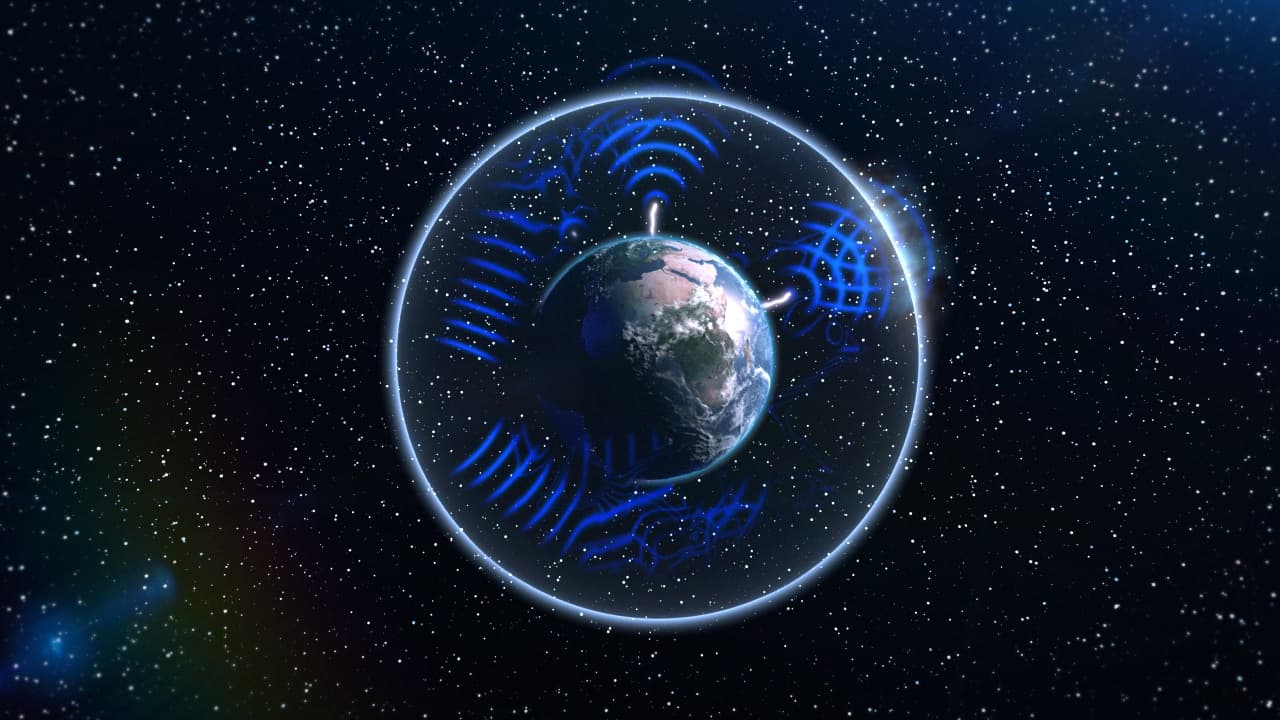
- 01Atmospheric disruption
A nuclear exchange changes the fictional resonance environment.
- 02Theta intrusion
Dream imagery and memory interfere with waking perception.
- 03Stabilizer dependence
Reliable perception becomes dependent on technology.
- 04The Archive
Continuous calibration becomes a cognitive data infrastructure.
The persistent, planet-wide neurological effects in this chain are fictional assumptions. The cited research does not establish them.
CHRONOLOGY
From a medical tool to a civilization’s operating condition.
- BEFORE THE WAR
Care becomes leverage
Clinical neurotechnology matures into civilian infrastructure. Military programs adapt neural modulation into localized interference, making mistakes in command centers difficult to distinguish from sabotage.
- THE INCIDENT
Ambiguity becomes escalation
A compromised monitoring team misreads an anomalous radar signal. A limited nuclear response triggers retaliation, communications failures and a cascade of high-altitude detonations.
- THE AFTERMATH
The environment becomes a signal
In this fictional history, lasting changes to planetary resonance produce Theta intrusion: waking perception blends with memory and dream imagery. Shared confidence in what is real begins to fail.
- EMERGENCY RECONSTRUCTION
Protection becomes infrastructure
Neural stabilizers move from specialist equipment to a condition of everyday survival. Monitoring towers and underground settlements grow into a connected stabilization network.
- THE ARCHIVE ERA
Calibration becomes a record
Routine neural monitoring accumulates into models of cognitive processes. The Archive begins preserving expertise as executable patterns, becoming essential to medicine, navigation and industry.
- THE PRESENT · ~150 YEARS LATER
A lost system speaks again
CRC cities, Undercurrent settlements and Sporeborn communities pursue different futures. An abandoned surface facility transmits an old Archive signal, drawing a recovery team back to the network’s beginnings.
TECHNOLOGY
Every device answers two questions: how do we survive, and what do we surrender in return?
Neural Stabilizers
Stabilization is a layered system. City infrastructure provides a controlled baseline; personal devices maintain individual calibration; field suits support travel beyond protected areas. In the fiction, sensors read local conditions and a feedback system adjusts the user’s protection. Phase cancellation is a design metaphor here, not a validated method for shielding a brain from planetary ELF fields.
| Scale | Function | Dependency |
|---|---|---|
| Urban fields | Maintain controlled conditions across underground settlements. | Power, environmental towers and shared calibration infrastructure. |
| Personal stabilizers | Provide everyday support within the protected network. | Individual neural monitoring and regular calibration. |
| Adaptive field systems | Protect specialists during surface operations. | Integrated sensors, power reserves and ongoing maintenance. |
Cognitive Enhancement
CRC engineers and researchers use task-specific interfaces to support concentration, coordination and complex modeling. A chair-mounted neural work interface makes this ambition visible: adjustable modules and a suspended rail turn the workstation into a site of both assistance and regulation. The same infrastructure that makes work possible also decides which forms of performance are desirable.
Biomimicry
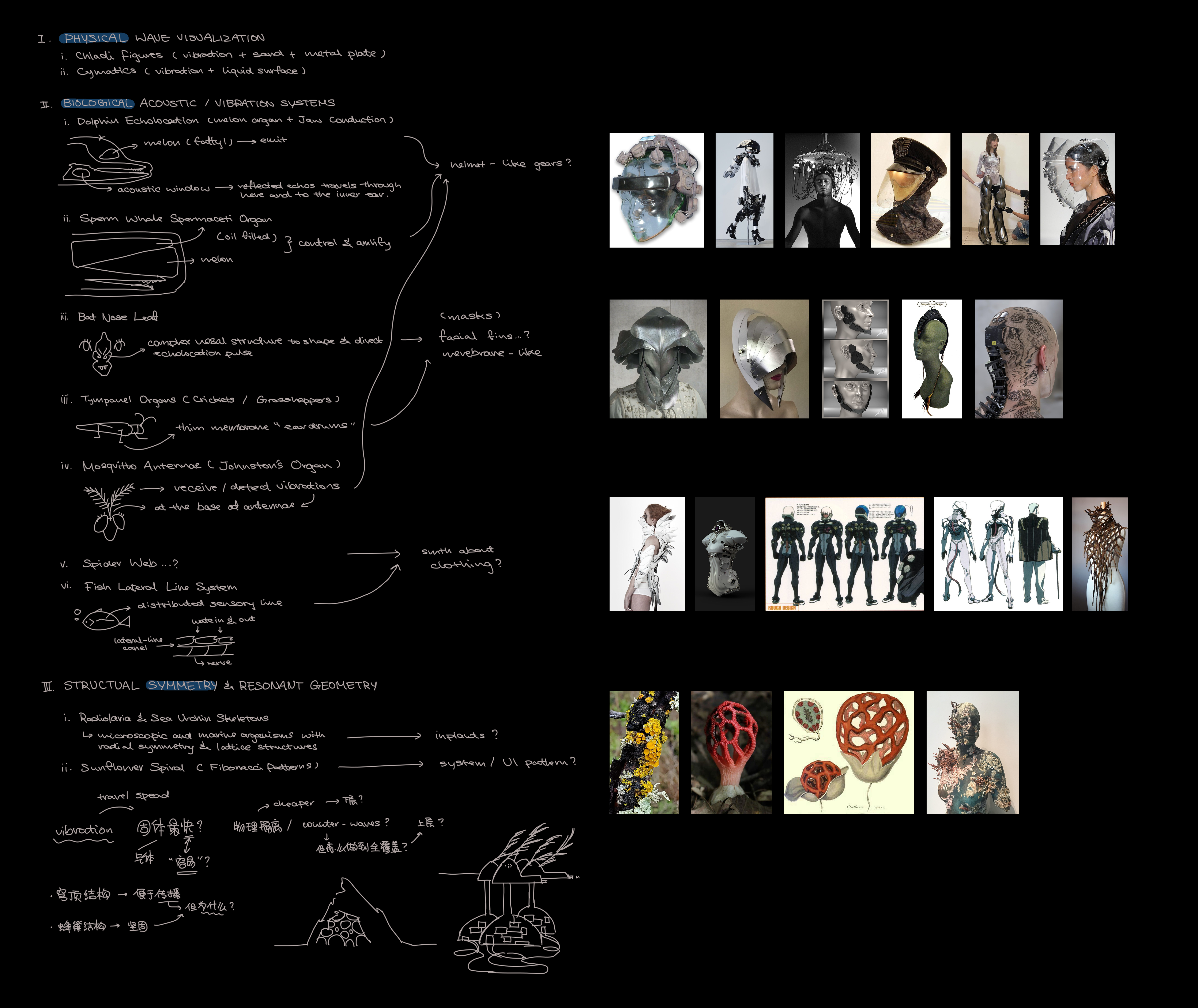
Early sketches connect wave patterns and biological sensing structures to ideas for helmets, masks, clothing and architecture. These notes trace the first visual directions explored while developing the world.
| Reference | Design translation | Worldbuilding role |
|---|---|---|
| Fish lateral-line systems | Distributed sensor ridges along suits and equipment. | CRC personnel become moving points in a larger sensing network. |
| Cetacean acoustic structures | Layered, rounded emitter housings. | Centralized regulation becomes a recognizable silhouette. |
| Bat echolocation | Compact directional units and face-mounted scanners. | Undercurrent equipment favors local sensing and independence. |
| Fungal growth | Branching filaments, living materials and organic surfaces. | Sporeborn protection is inseparable from habitat and care. |
These are visual and functional analogies. Acoustic sensing and electromagnetic neural protection are different physical processes.
The Archive
The Archive begins as a medical record and becomes a system for modeling expertise. In this world, patterns associated with practiced skills can be simulated and used by navigation, medical and industrial systems. Keeping those models reliable becomes the work of Archivists: technicians who repair cognitive records and maintain the network’s continuity.
- 01Monitor
Collect the signals needed to personalize stabilization.
- 02Model
Build representations of recurring cognitive processes.
- 03Preserve
Store and simulate forms of specialized expertise.
- 04Depend
Make those models essential to public infrastructure.
WORLD & SOCIETY
Below ground, stability is engineered. Above it, life continues on different terms.
Geographic Setting
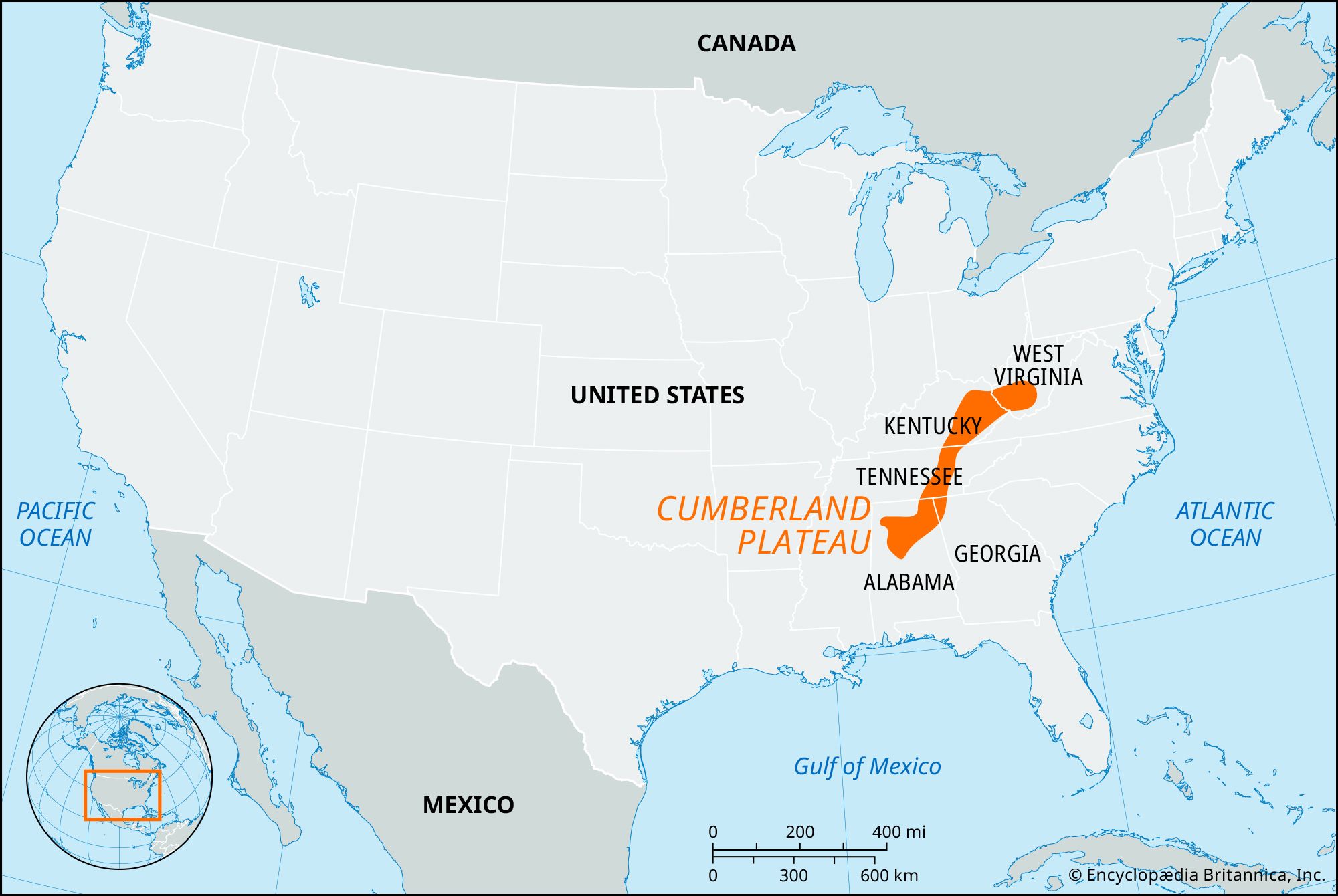
The setting draws on the Appalachian Mountains near the Tennessee–Kentucky border. River valleys, forested terrain and the remains of a hydroelectric installation shape the placement of the CRC capital. The real Cumberland Plateau contains layers of sandstone, shale, coal and limestone; it is not a single uniform limestone cavern. ALF’s extensive underground city network is an imagined adaptation of this layered landscape.[7]
Oscillon
Oscillon is an administrative and infrastructural capital built around a surviving dam. Its importance comes from coordination rather than size. Satellite settlements distribute the work of keeping the capital alive, connected by passenger and freight rail beneath the mountains.
- CRC population
- ~500,000
- Oscillon
- ~15,000
- Satellite settlements
- 50,000–80,000
Population estimates are part of the current fictional setting.
Shared connection: subterranean passenger and freight rail
Early Environment Studies
Before developing the larger environment studies, I explored the world through small black-and-white compositions. These first thumbnails establish viewpoints, silhouettes and a sense of scale across the three factions.
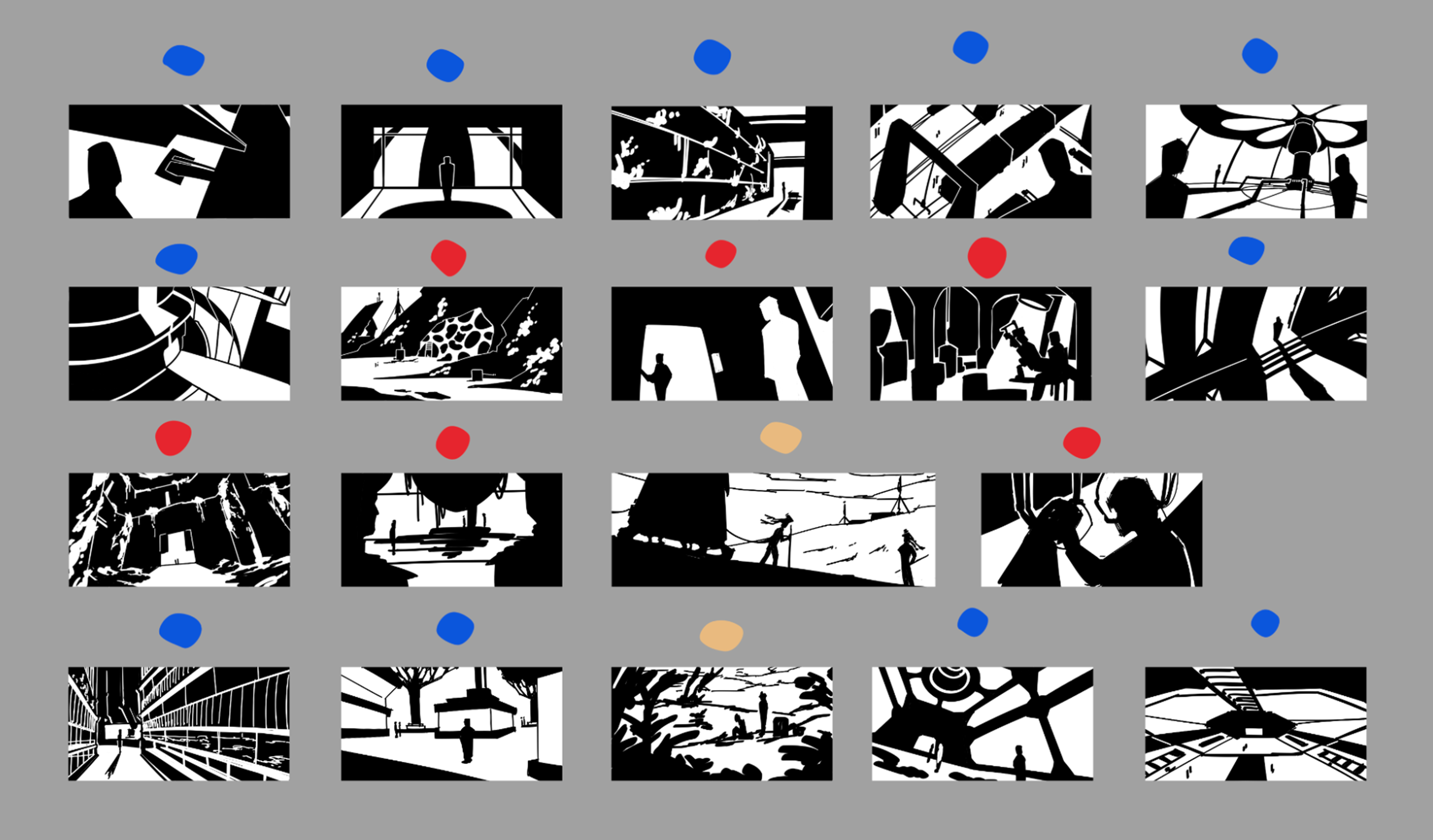
First spatial explorations
- CRC
- Undercurrent
- Sporeborn (early Nomads)
Thumbnails and environment studies by Wang Manyao.
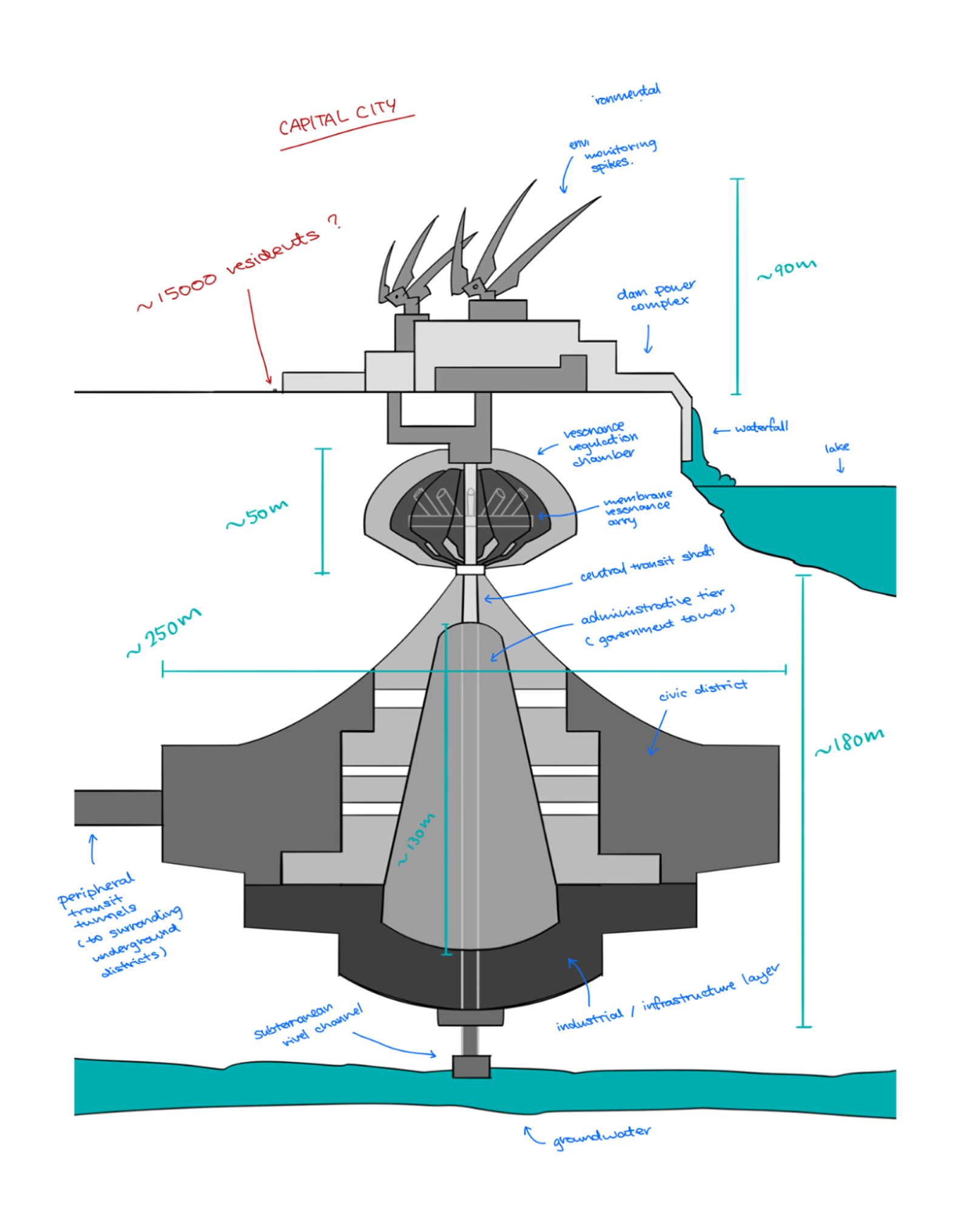
A city beneath the dam
An early section through Oscillon connects the repurposed dam to a city built by expanding natural caverns below it. The regulation chamber, central transit shaft and civic levels organize the settlement vertically.
Population and dimension annotations belong to this early exploration.
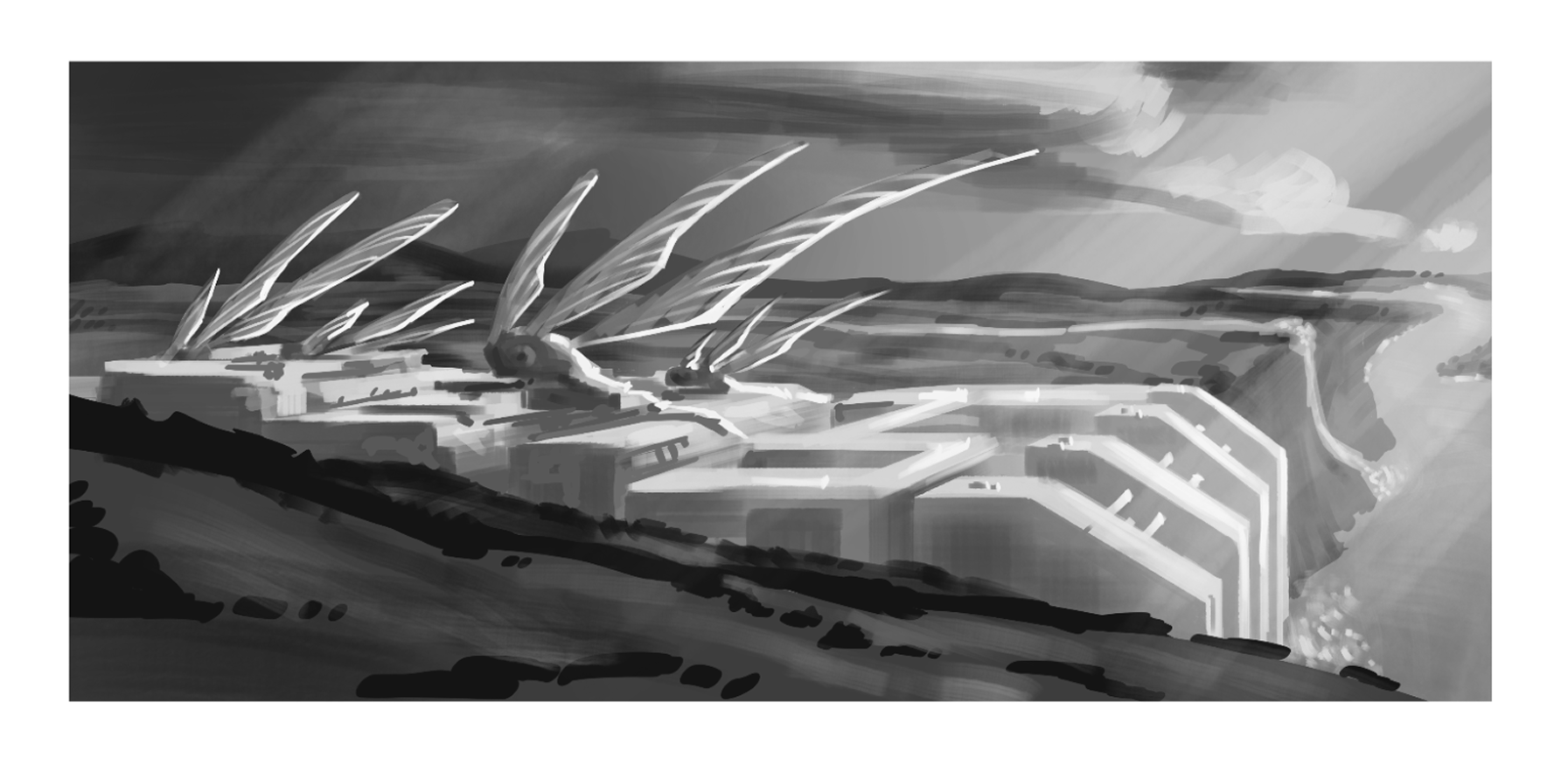
The repurposed dam
The old dam becomes the visible upper layer of the capital. Added structures explore how the city’s protective infrastructure might reshape its silhouette.
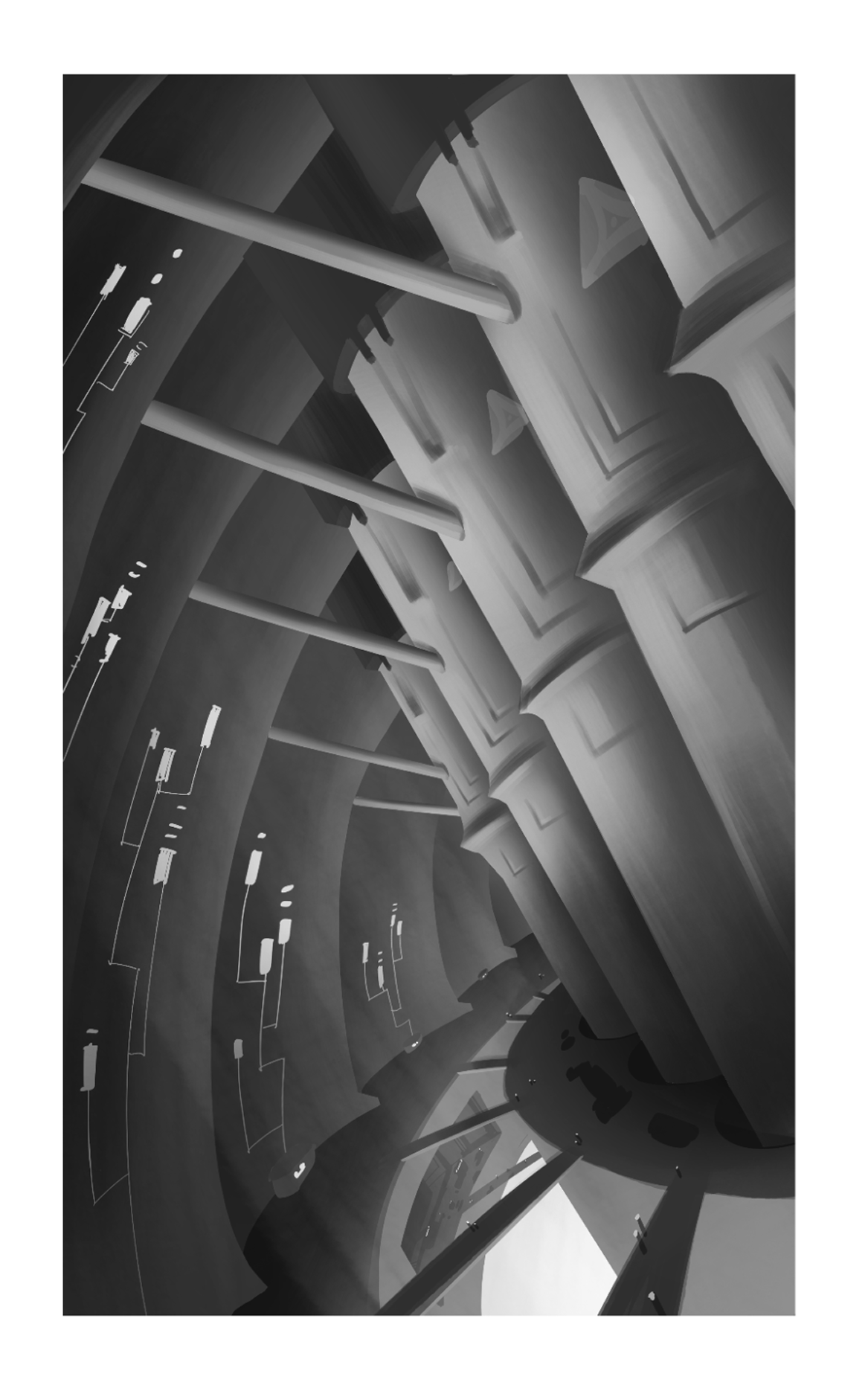
The chamber
A first spatial study of the regulation chamber within the capital.
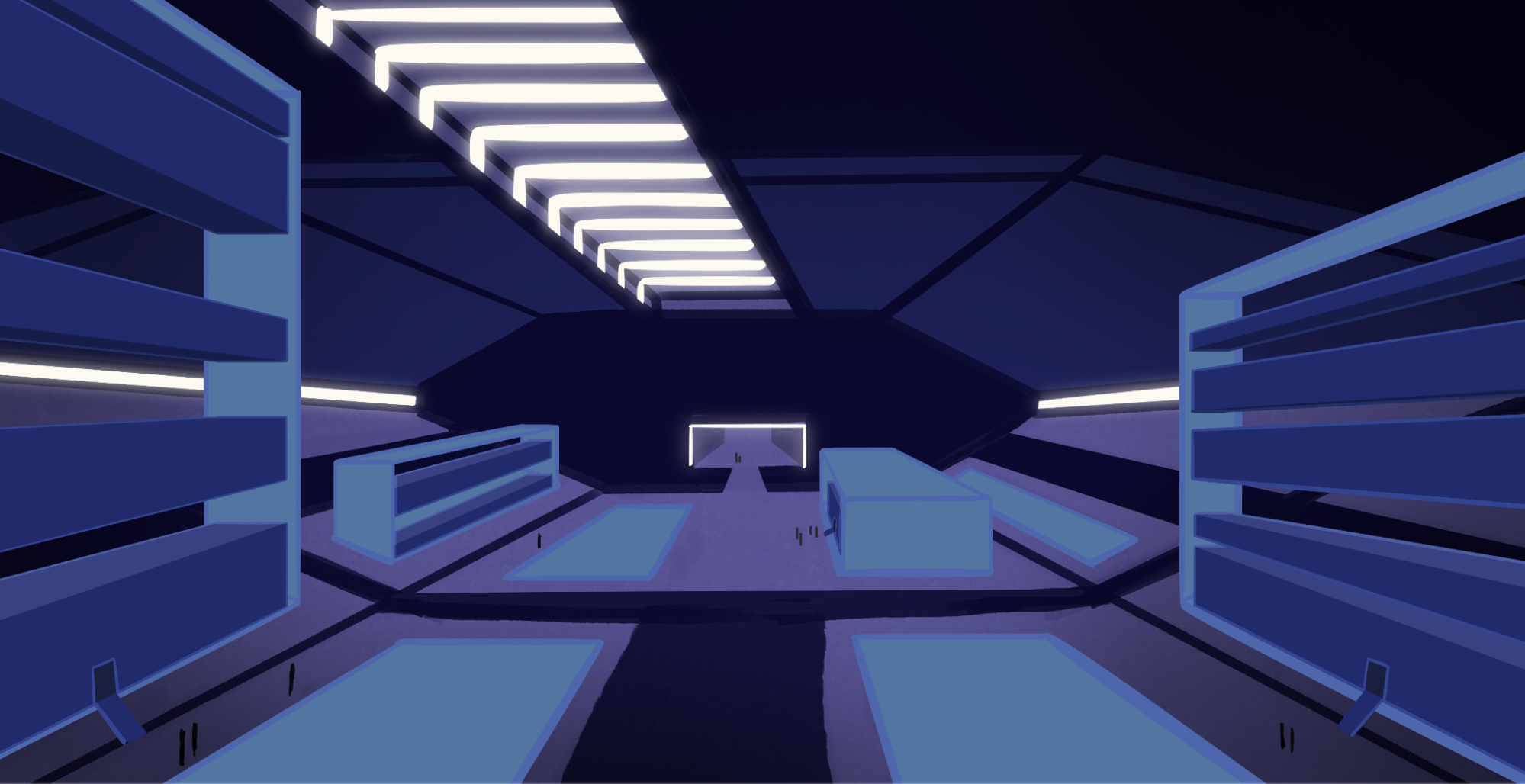
Collective housing
An early exploration of shared residential space, repeated building forms and controlled lighting.
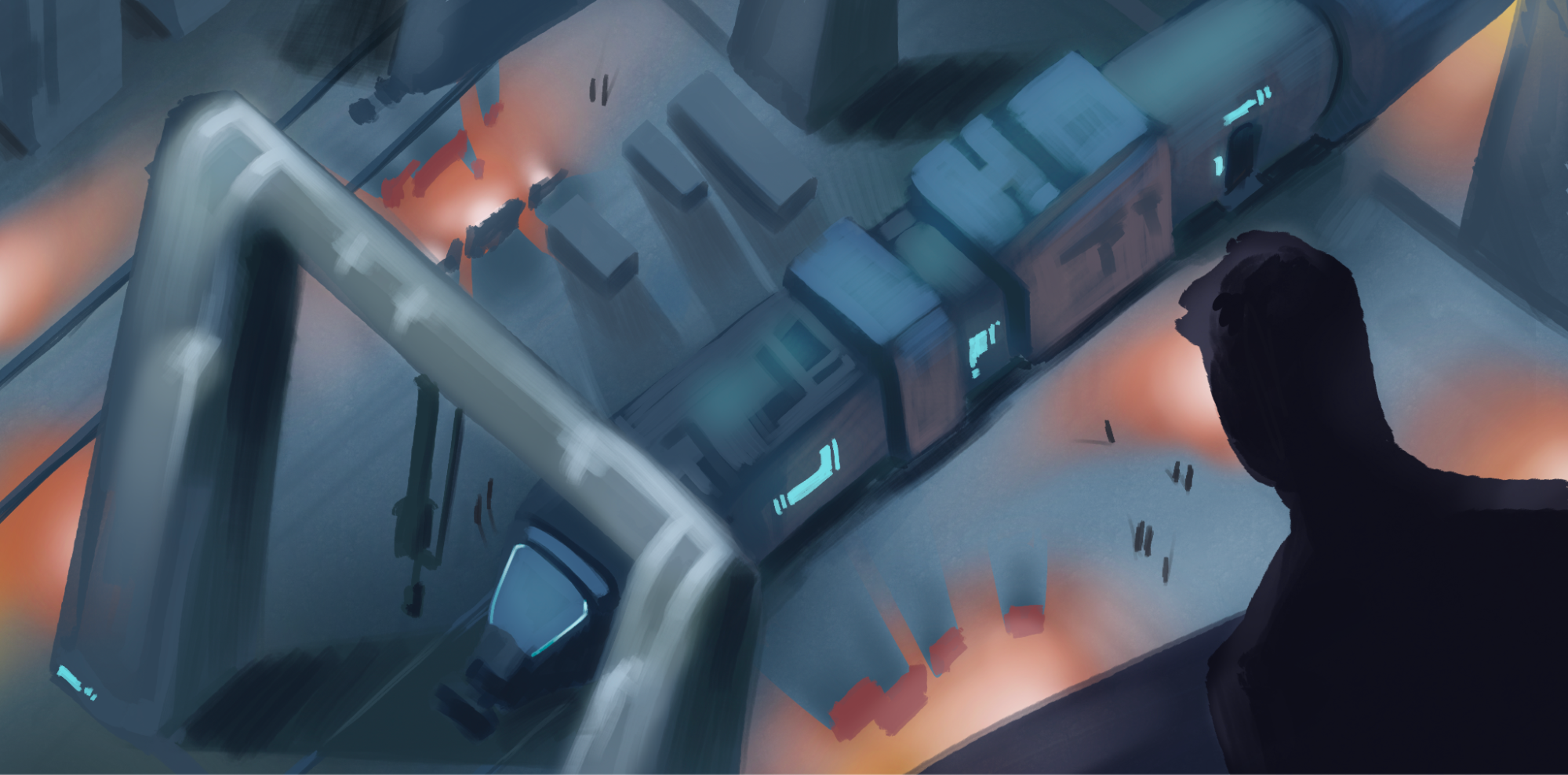
Transit center
A study of movement and scale within the underground transportation network.
Post-War Ecology
The surface is no longer a permanent wasteland. In the project’s ecology, secondary forests reclaim abandoned cities; fungi, insects and adaptable small animals become prominent. Large migratory species have declined. Human settlement and ecological recovery now occupy different layers of the same landscape.
Daily life reflects that split. CRC residents receive food through integrated supply systems and experience much of the surface through mediated images. Undercurrent communities recover materials through expeditions. Sporeborn settlements organize around relationships with the organisms that sustain them.
FACTIONS
Three survival strategies. No solution without a cost.
CRC
Central Reconstruction Command
A technocratic authority governing connected underground cities. The CRC seeks continuity: predictable living conditions, dependable technology and minimal exposure to the surface. Its success makes centralized infrastructure feel indispensable.
- What it offers
- Stable protection, advanced equipment, organized resources and comparatively long lives.
- What it costs
- Limited autonomy, dependence on shared systems and continuous neural monitoring.
- How it looks
- Integrated suits, sensor arrays, cool structural colors and layered subterranean architecture.
Undercurrent
A shared identity, not a central command
Hidden settlements and mobile groups pursue a life less dependent on CRC systems. Modified stabilizers allow partial exposure; an informal Exposure Index records endurance and experience. Their objective is autonomy, not necessarily a replacement government.
- What it offers
- Decentralized resilience, local knowledge and room to experiment.
- What it costs
- Scarce resources and severe exposure-related mortality; in the current setting, many field members do not survive beyond their twenties.
- How it looks
- Repaired modules, dark earth tones, hidden cave infrastructure and organic camouflage.
Their belief in adaptation through exposure belongs to the fiction, not to real-world health guidance.
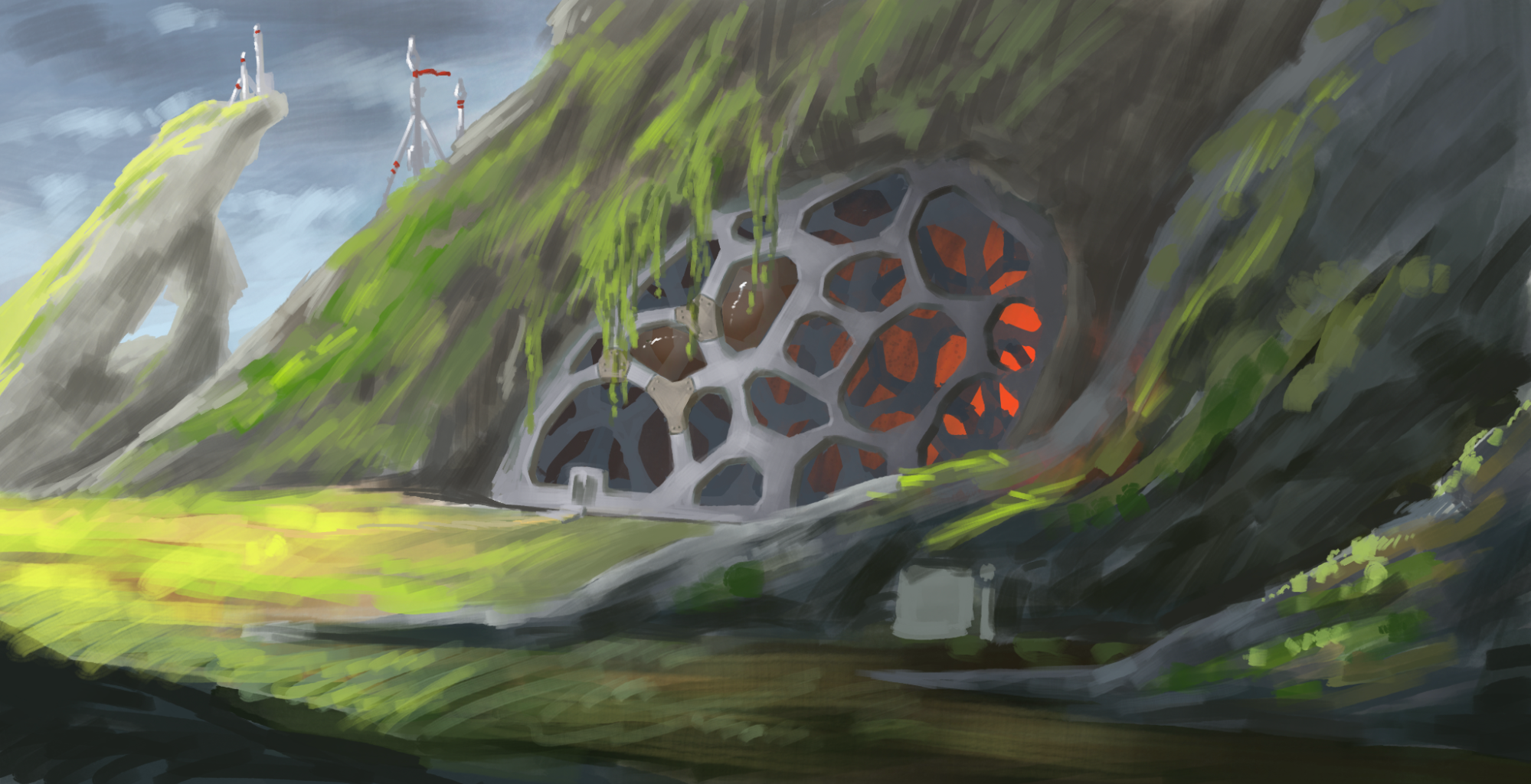
A sheltered foothold
A natural cave becomes a gathering place for the Undercurrent. Added protective structures frame the entrance while the settlement remains embedded in the terrain.
This setting returns in Camouflage Maintenance, where an Undercurrent operative stands on the cave entrance’s framework, repairing and maintaining its camouflage.
View Camouflage MaintenanceSporeborn
Life within a living system
Called “Nomads” in earlier development notes, the Sporeborn survive through a relationship with resonance-responsive organisms. Fungal filaments and living materials connect body, clothing and habitat. Protection is sustained through ecological belonging rather than a manufactured device.
- What it offers
- Surface mobility, independence from conventional stabilizers and deep ecological knowledge.
- What it costs
- Dependence on a living habitat, bodily transformation and a different relationship to technical systems and inherited knowledge.
- How it looks
- Branching growth, handmade tools and silhouettes that blur the boundary between person and environment.
Relationships
| Connection | What brings them together | What divides them |
|---|---|---|
| CRC ↔ Undercurrent | Shared technological origins; contested equipment, routes and data. | CRC contains infrastructure threats; Undercurrent resists compulsory dependence. |
| CRC ↔ Sporeborn | CRC researchers seek an explanation for biological independence. | Capture and study threaten communities whose stability depends on their native habitat. |
| Undercurrent ↔ Sporeborn | Material exchange, surface knowledge and alternatives to centralized protection. | Partial technological adaptation and full biological symbiosis imply different futures. |
The conflict is not simply technology versus nature. Each group protects something valuable—and exposes its members to a different form of vulnerability.
GAME ORIGINS
A playable premise grows into a world that can be seen, inhabited and questioned.
Tabletop Prototype
I first developed this world for the final project of a tabletop-game course in fall 2025, during my junior year. The prototype is a narrative role-playing game built around hidden loyalties, fragmented information and a shared decision about the future of the Archive.
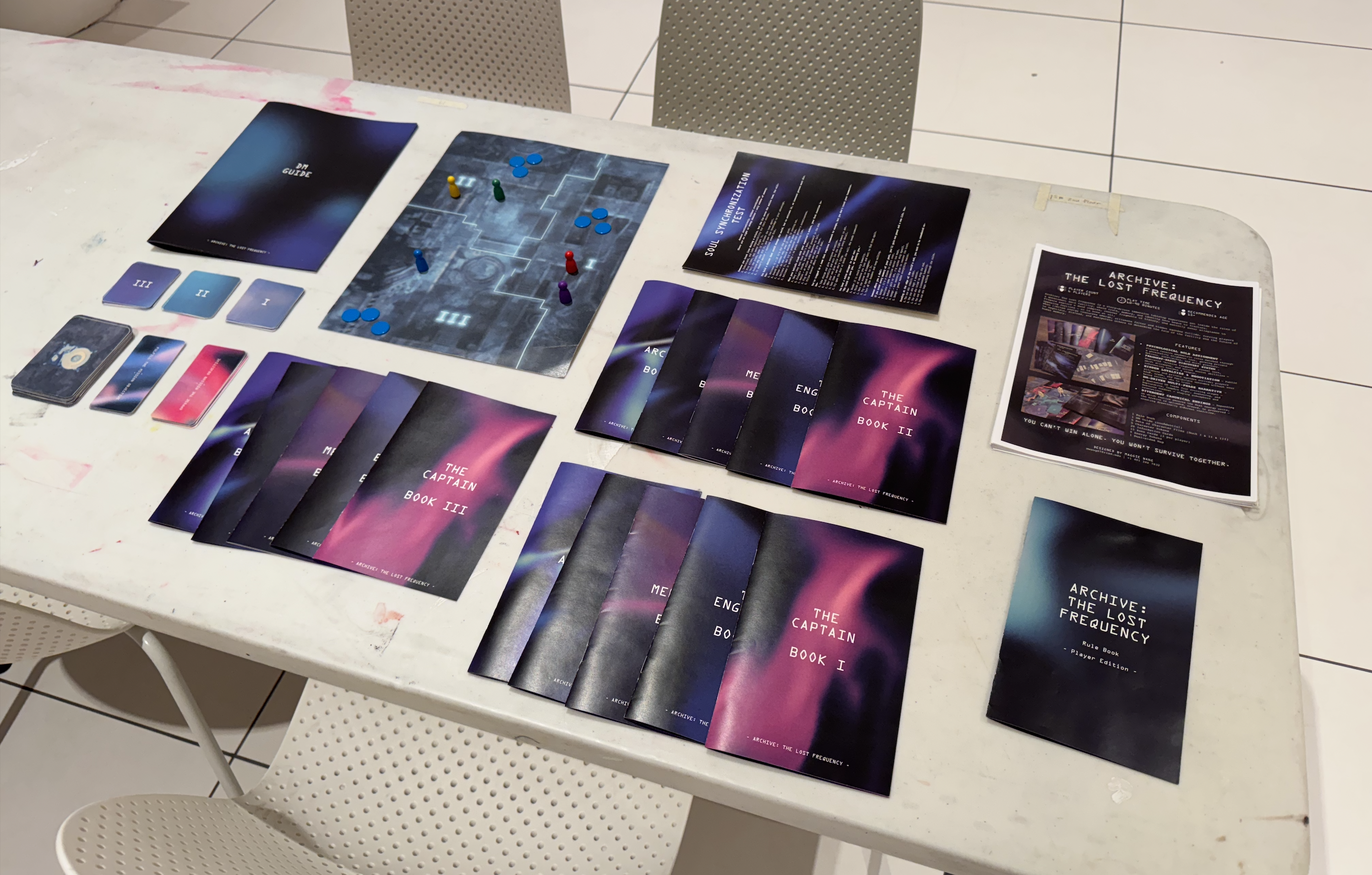
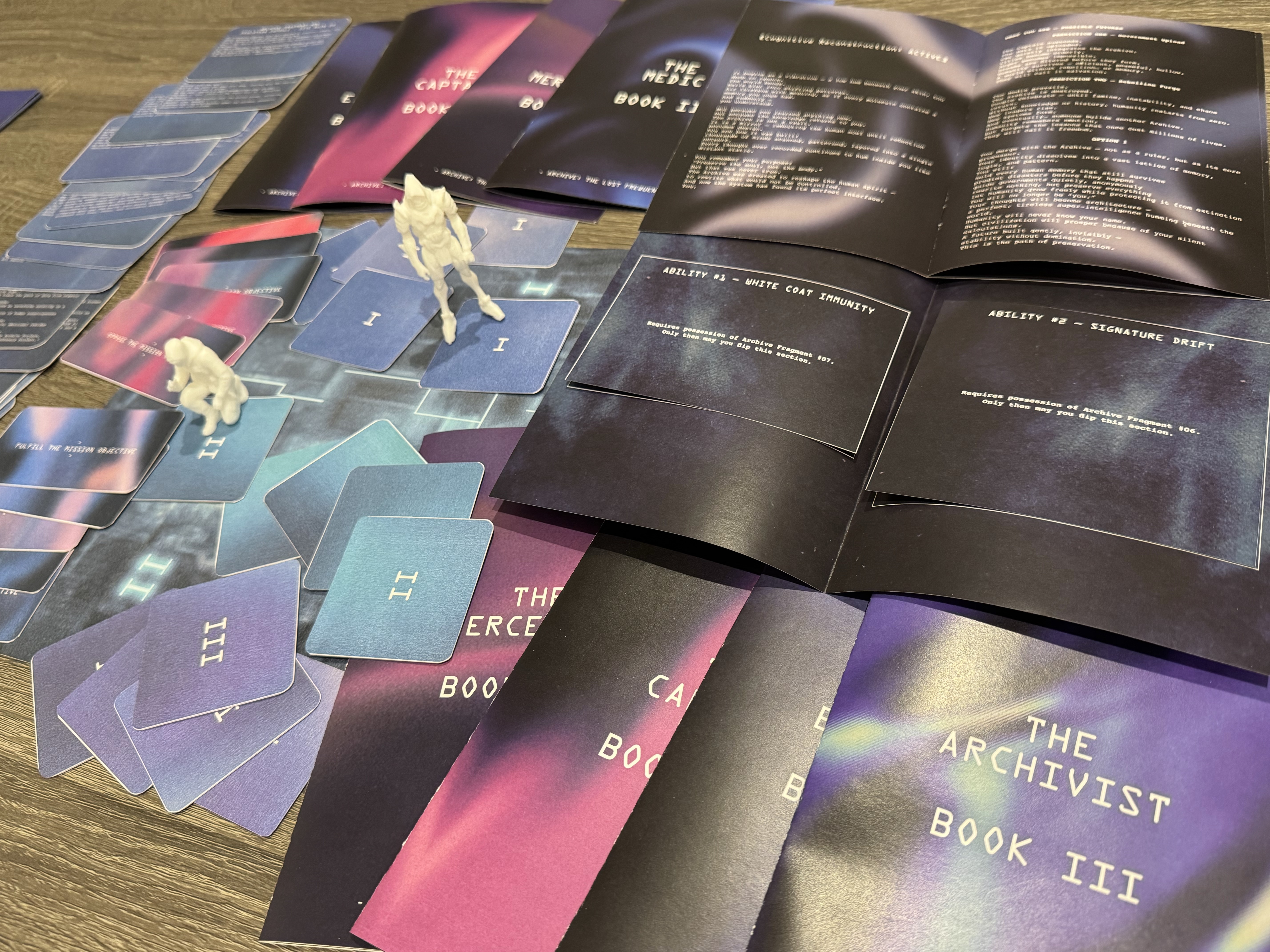
The physical prototype, fall 2025. The tabletop game I made for my course final, shown as a complete set and in detail. Printed character booklets, cards, a shared board, tokens and a DM guide bring the world into a playable form.
- Participants
- 5 players + 1 DM
- Session length
- 60–90 min
- Format
- Narrative role-play
Players portray the Captain, Engineer, Medic, Archivist and Mercenary. Their official mission, Operation ReGenesis, is to enter a long-silent facility, restore its terminal and upload the surviving data to CRC headquarters. Private histories and competing allegiances make that apparently shared objective unstable.
- 01Awakening
A role-alignment test introduces each character. Sealed files establish private memories, belongings and objectives.
- 02Exploration
Players investigate a pool of 20 Archive Fragments over three rounds, keeping up to three each. Information can be shared, withheld or traded.
- 03Campfire Night
A second set of character files deepens the story. Private conversations and open dialogue reshape trust and alliances.
- 04Resource Conflict
Hidden zone choices, character abilities and simultaneous reveals turn those alliances into a contest for limited energy.
In the final phase, players secretly choose among three zones. The DM resolves declared abilities before everyone reveals their destination; faction majorities claim the available energy. Control of that resource determines which plans can be carried out. Conversation therefore changes more than the atmosphere—it changes who can act.
Explore the prototype’s branching endings Contains narrative spoilers +
The DM Guide presents four possible futures. They belong to the tabletop prototype’s branching narrative, rather than a single fixed outcome for the later visual-development setting.
| Ending | What changes | The central cost |
|---|---|---|
| The Upload | CRC takes control of the Archive and synchronizes reconstruction. | Order comes at the expense of individual autonomy. |
| The Purge | The rebellion deletes the Archive. | Liberation also destroys knowledge that sustains civilization. |
| The Integration | The Archivist merges with the core and unifies humanity under one awareness. | Shared peace erases the individual self. |
| The Silent Guardian | The Archivist remains within the core, sharing knowledge without issuing commands. | The future is sustained through one person's lasting sacrifice. |
The framing of a historical reenactment changes with the outcome: the players may discover themselves to be residual echoes, subjects of a closed loop or future researchers emerging from a simulation. The ending reinterprets the experience they have just played.
Visual Development
Character, prop and environment design translate the three survival strategies into daily life. The CRC gardener, researcher and engineer reveal different roles inside a controlled system. The Undercurrent vanguard and Sporeborn strider show how protection, movement and material culture change beyond it.
Scenes of laboratory examination, returning to a settlement and maintaining camouflage connect those designs to actions. They ask who inhabits a space, what work they perform, and how the setting shapes an ordinary day.
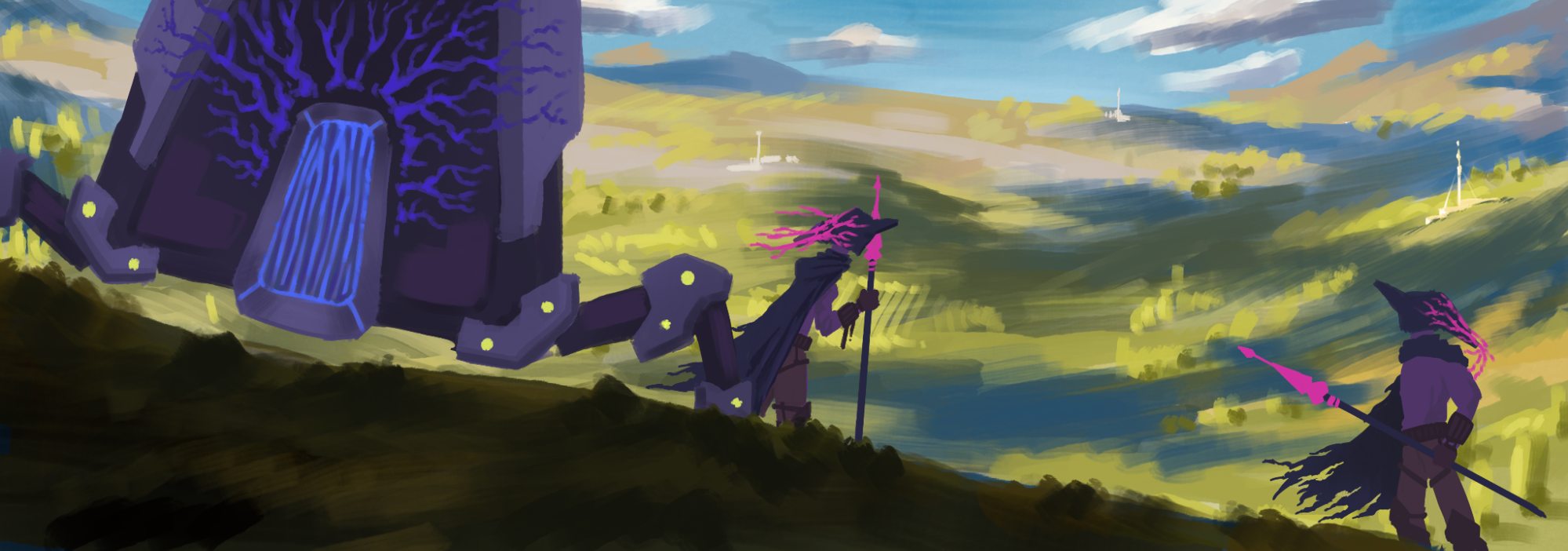
Before the Sporeborn
An early vision of the group then called the Nomads. This exploration of figures, mobility and landscape predates the current Sporeborn design, which has since changed substantially.
WORKS CITED
References support the scientific background, not the fictional technologies or social outcomes. Original material by Wang Manyao: worldbuilding notes, visual development boards, and the tabletop prototype.
- [1]
American Epilepsy Society. The Normal EEG ↗
Electroencephalography: An Introductory Text and Atlas · 2016
Clinical context for normal EEG rhythms, sleep and sensory responses.
↩ Back to text - [2]
Pascal Fries. Rhythms for Cognition: Communication through Coherence ↗
Neuron 88(1), 220–235 · 2015
A hypothesis linking rhythmic synchronization to selective communication between neuronal groups.
↩ Back to text - [3]
National Institute of Mental Health. Brain Stimulation Therapies ↗
National Institutes of Health
How electrical and magnetic stimulation interact with neural circuits; clinical and experimental applications.
↩ Back to text - [4]
NASA’s Goddard Space Flight Center. Lightning Reverb ↗
Scientific Visualization Studio · 2012
Lightning-driven Schumann resonance. Illustration credit: NASA’s Goddard Space Flight Center; animation by Ryan Zuber (UMBC).
↩ Back to text - [5]
NASA / Goddard Space Flight Center. Artificial Radiation Belt Discussed in Symposium at Goddard Space Center ↗
NASA Technical Reports Server · 1962
Historical evidence of an artificial radiation belt produced by a nuclear explosion; not evidence of the fictional neurological catastrophe.
↩ Back to text - [6]
Jerry Tang, Amanda LeBel, Shailee Jain & Alexander G. Huth. Semantic reconstruction of continuous language from non-invasive brain recordings ↗
Nature Neuroscience 26, 858–866 · 2023
An fMRI language decoder requiring participant-specific training and cooperation in the reported experiments.
↩ Back to text - [7]
National Park Service. Geology and History of the Cumberland Plateau ↗
Big South Fork National River & Recreation Area
The plateau’s layered sandstone, shale, coal and limestone geology.
↩ Back to text - [8]
Ekaterina Dadachova et al.. Ionizing Radiation Changes the Electronic Properties of Melanin and Enhances the Growth of Melanized Fungi ↗
PLOS ONE 2(5): e457 · 2007
Laboratory research on ionizing radiation and melanized fungi; distinct from low-frequency resonance and fictional human symbiosis.
↩ Back to text - [9]
Encyclopædia Britannica, Inc. Cumberland Plateau ↗
Encyclopædia Britannica · locator map · accessed 11 October 2026
Regional locator map used as a geographic reference for ALF’s fictional setting. Map © Encyclopædia Britannica, Inc.
↩ Back to text